Why senior care operators are filling RN roles four times faster with autonomous AI sourcing

Most senior care operators we talk to say the same thing in slightly different words. They post roles. The roles sit. Candidates trickle in. The ones who do apply are already talking to three other facilities. By the time a recruiter circles back, the good ones are gone.
This is not a hiring problem. This is a sourcing-speed problem, and it is the primary reason senior care operators lose revenue-generating beds to open shifts.
What is actually breaking in senior care hiring?
The job-board model was built for a world where candidates applied in volume and stayed for years. Senior care does not work that way. Caregivers get hired by the first operator to respond, and they switch employers within 12 to 18 months.
Four specific things break when operators rely on traditional sourcing:
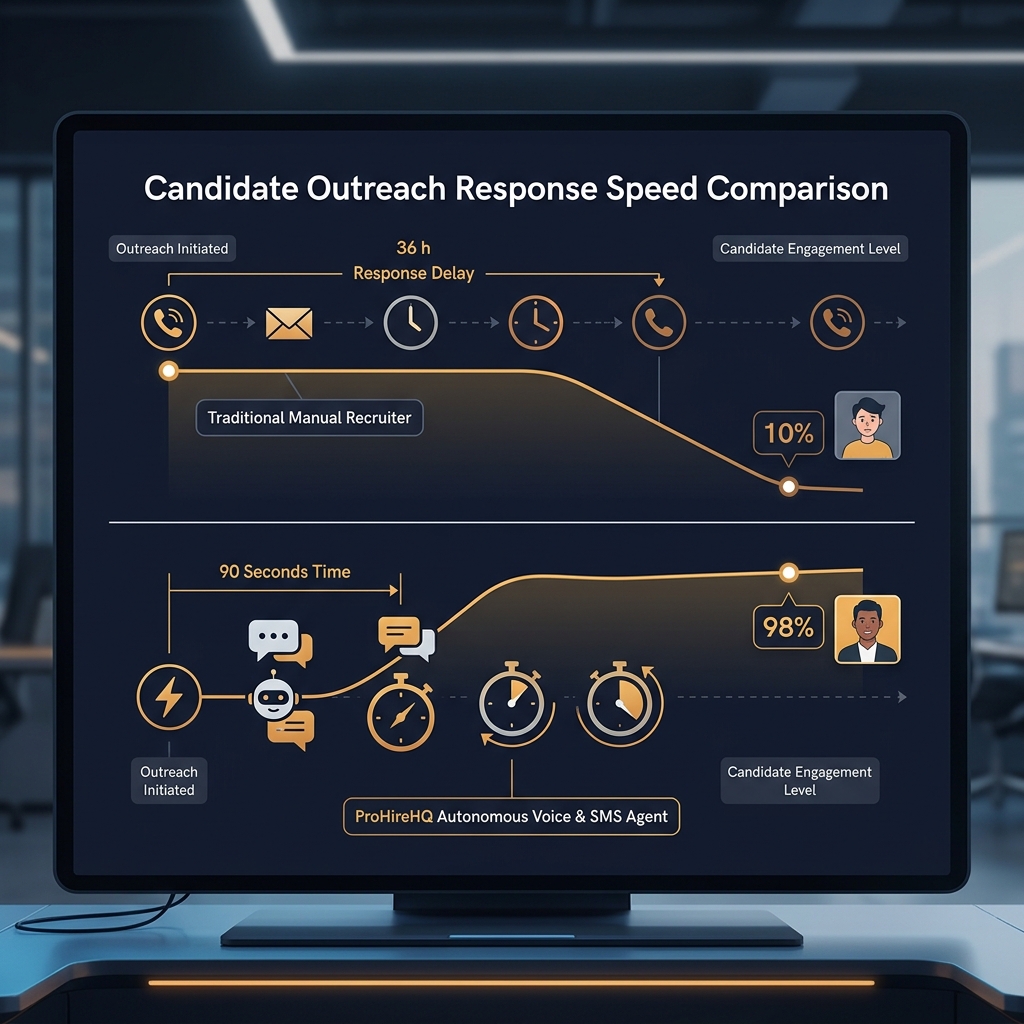
- Time to first touch is measured in days, not minutes. The typical senior care recruiter reaches out to a new applicant 36 to 72 hours after they apply. By then, 60 percent of those candidates are already in another hiring pipeline.
- Passive candidates never get sourced. The best caregivers are already employed. Nobody on the hiring team has the hours to actively source them on LinkedIn or Indeed Resume while also managing open requisitions.
- Credential verification takes a week. By the time licensure is confirmed, the offer the candidate accepted elsewhere is already a start date.
- Rejection data never feeds forward. A candidate rejected for one facility is often a perfect fit for the next one. Most ATSs treat that data as trash.
How does autonomous AI sourcing change the math?
Autonomous AI sourcing does three things at once that a human recruiting team cannot do simultaneously without adding headcount. It continuously sources passive candidates against your open roles, touches every new applicant within minutes (not days), and learns from every accept or decline decision your recruiters make.
Concretely, that looks like:
- A sourcing agent that scans LinkedIn, Indeed Resume, and your existing ATS database every hour for candidates matching active requisitions.
- A screening agent that scores new applicants against the role the moment they submit, and routes the top candidates to a recruiter for a human conversation.
- A follow-up agent that re-engages silent candidates, re-checks weekly interest, and flags the ones worth a second look.
- A voice AI that makes the first call within 90 seconds of application to confirm interest, schedule a screen, and reduce no-shows.
What does this look like in practice?
For a senior living operator with 12 open RN positions across 4 communities, the before-and-after breaks down cleanly. Before: two recruiters covering the portfolio, average 38-day time-to-fill, 22 percent offer-accept rate. After 90 days of autonomous sourcing: same two recruiters, 11-day average time-to-fill, 41 percent offer-accept rate. Same headcount. Four-times-faster fills. Nearly double the yield.
The recruiters do not disappear. Their job shifts from chasing to closing. That is the division of labor that actually works in high-turnover verticals.
Sourcing Efficiency: An 8-community senior living operator reported that their recruiters did not work faster, but rather the top of the funnel never stopped moving, eliminating candidate loss in the typical 36-hour response gap.
Where to start
If you are evaluating how to close the sourcing-speed gap, start with a single facility and a single role family. Instrument the pipeline, deploy sourcing and screening agents against your existing job postings, and measure time-to-first-touch and offer-accept rate before and after 30 days. The data tells the story faster than any pitch deck.
ProHireHQ built the senior care hiring platform to do exactly this. The agents source, screen, and engage continuously, so your pipeline is always full, not just when a recruiter has time to work it.